
1. The reported development
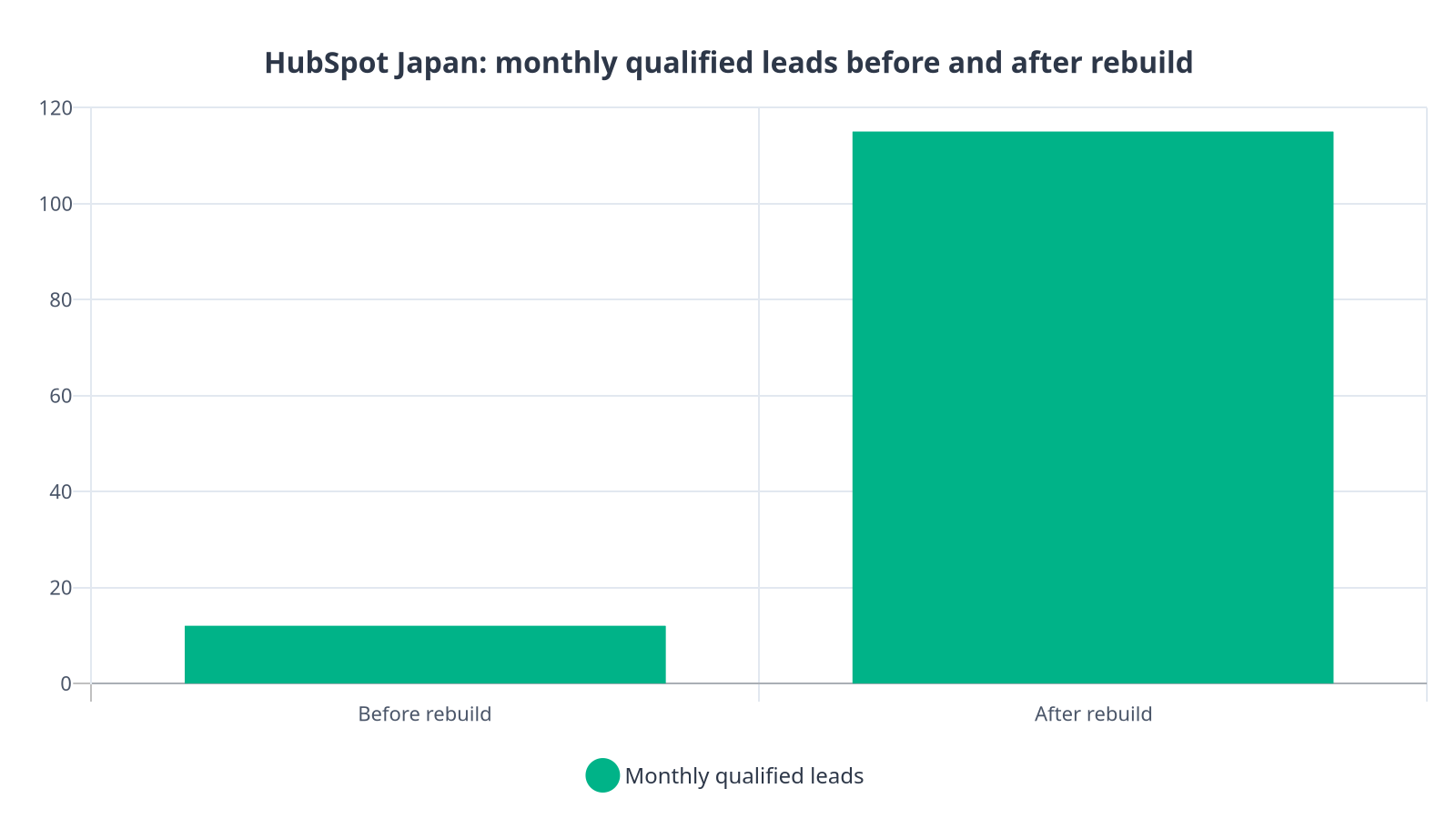
A recent HubSpot Marketing Blog post by Sophia Zamora Barbosa describes how HubSpot rebuilt its Japan email automation programs from near-zero performance to what the company reports as roughly 9x growth in qualified leads, moving from approximately 12 per month to over 115. According to the post, the effort required about 12 days of automation marketer time over two months, five days of regional marketer time for QA, and no additional headcount. The output: 71 emails and 38 workflows built from scratch across two programs.
The post frames the problem as structural rather than market-specific. HubSpot's automation investment had historically concentrated on a few core language markets (English, French, Spanish, German, Portuguese). Japan's programs were "years old, partially built, or never meaningfully localized," per the post. The typical fix, hiring a local automation specialist, was not pursued.
This pattern will be familiar to any enterprise marketing operations team running always-on campaigns across multiple geographies. Secondary markets accumulate technical debt quietly, often for years, because automation expertise stays scoped to volume markets.
Source: HubSpot Marketing Blog, Sophia Zamora Barbosa, October 2026
2. The operating model: splitting technical from cultural
The central idea is a clean separation of two jobs that teams typically bundle into one role. As described in the post, the automation marketer owned journey design, workflow setup, segmentation logic, enrollment criteria, email structure and timing, technical QA, and reporting. None of this required Japanese fluency.
The regional marketing partner owned cultural validation: confirming that messaging, pain points, tone, and the overall customer experience were appropriate for Japanese audiences. The post is specific that this person was not a translator. "A native speaker who doesn't know how Japanese SMBs evaluate software is not the right person for this role," it states. AI was used to produce first drafts, which the regional partner refined and validated. Their total time commitment was five days across the entire project.
This decomposition has implications for how enterprise teams think about campaign production and marketing automation strategy. The bottleneck in most secondary-market programs is not budget. It is the assumption that one person must own both the platform mechanics and the local market knowledge.

"A native speaker who doesn’t know how Japanese SMBs evaluate software is not the right person for this role."
-- Sophia Zamora Barbosa, Author, HubSpot Marketing Blog | HubSpot Marketing Blog, October 2026
3. Why high-intent programs came first
The post draws a deliberate distinction between high-intent and low-intent automation programs. High-intent programs target contacts already showing early buying signals: pricing page visits, product feature browsing, or other evaluative actions. Low-intent programs are broader nurture flows with larger email volumes and longer conversion paths.
HubSpot chose to rebuild only high-intent, trigger-based emails first. According to the post, these programs have fewer emails, more focused messaging, and clearer calls-to-action, making them faster to build and easier to localize. The post attributes the 9x growth in qualified leads directly to this prioritization.
This echoes a pattern we have observed across platforms: automated flows produce most email revenue, yet most teams still ignore them. Trigger-based programs consistently outperform batch sends on a per-message basis. Starting a market rebuild with these programs gives teams a measurable signal quickly, which in turn justifies expanding to broader nurture.

4. Applicability and practical recommendations
The post includes a go/no-go checklist. The model works, according to HubSpot's criteria, when automation is non-existent, outdated, or underperforming; a large enough high-intent audience exists (roughly 2,000 contacts per month entering programs, in their case); a qualified local partner is available; and that partner can commit minimal time.
Consider auditing every secondary market in your automation platform for three signals: the number of active workflows, year-over-year email delivery volume trends, and the gap between automation-sourced qualified leads and goal. These signals, drawn from the post's playbook, determine whether the market needs a full build, a rebuild, or is already performing adequately.
We recommend separating technical and cultural responsibilities explicitly in your campaign maturity assessment. Most maturity models evaluate platform capability and content quality on the same axis. Splitting them reveals which markets are technically capable but culturally stale, a condition that produces technically correct emails that do not convert.
Consider starting any secondary-market rebuild with high-intent trigger programs only. The post's playbook suggests a simple test: "Would this email make sense to send to someone who visited your pricing page today?" If yes, build it first. Layer low-intent nurture programs in after the foundation is live and producing measurable results. Teams running multi-touch campaigns across regions can apply this filter to prioritize build effort.
We recommend building a shared messaging guide before writing a single email. The post specifies six questions to answer with the local partner: primary audience, top three pain points, which global messages resonate locally, appropriate tone, most credible proof points, and what to avoid. Both parties sign off before anything is built. This step is where most rushed localizations fail, and it is where a buying behaviour analysis for the target market pays for itself.
The HubSpot post describes a single case with self-reported results. Independent validation of the 9x figure is not available. Still, the operating model itself, separating platform mechanics from cultural context, is sound and applicable across Oracle Eloqua, Adobe Marketo, Salesforce Marketing Cloud, and HubSpot. The constraint it addresses, scarce automation expertise concentrated in primary markets, is one of the most common and least discussed inefficiencies in enterprise email operations.