
1. The readiness illusion
SAP's AI in Customer Experience Report, based on a survey of 4,800 respondents across the United States and Germany, contains a statistic that should stop enterprise marketing leaders mid-sentence. According to the report, as cited by MarTech, more than 90% of CX leaders believe they are ready for AI agents. The actual share of U.S. companies with connected systems to support those agents is 6%. In Germany, the figure drops to 3%.
The gap between confidence and capability is not a rounding error. About three-quarters of marketing teams already use AI for content, campaigns, and lead generation, but these deployments remain siloed. As MarTech's Mike Pastore writes, "using AI to complete individual tasks doesn't fix broken customer experiences." The report's implication, in Pastore's framing, is that disconnected systems leave AI agents "making promises the business can't fulfill."
This matters because the buying journey has already shifted. The SAP report found that 95% of U.S. B2B buyers and 99% of German B2B buyers use AI to research and compare options before reaching a brand's owned channels. Meanwhile, nearly 80% of CX decision makers reported that customers have to repeat information across channels and experience stalled handoffs.
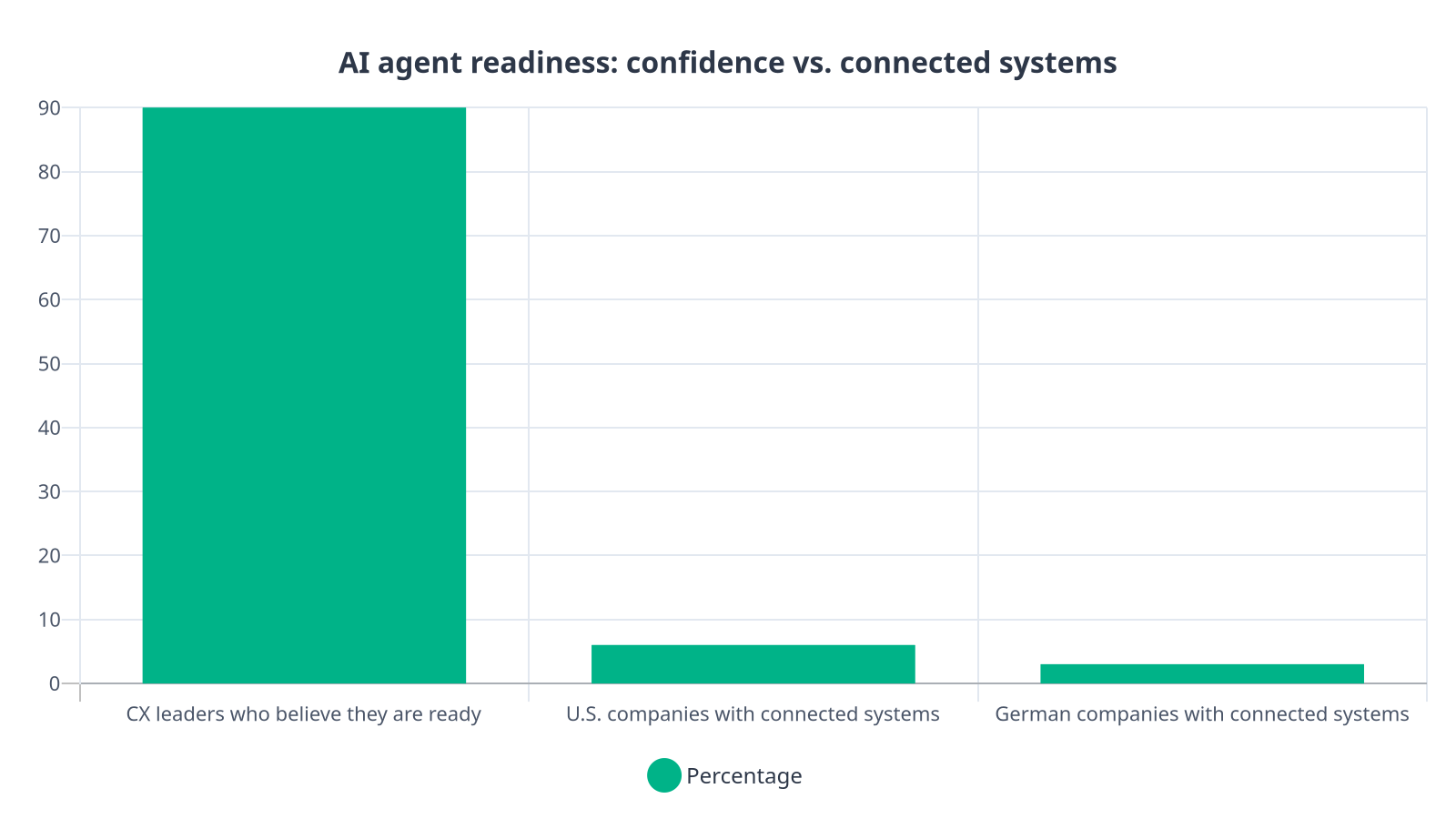
Source: SAP AI in Customer Experience Report (as cited by MarTech)
2. Why marketing operations is a natural owner
The report's findings, as summarized by MarTech, read like a brief for marketing operations. Discovery now depends on structured, accurate product specs, pricing, and multi-modal assets that AI agents can parse. Channel transitions (from external AI assistants to brand websites to sales workflows) require persistent customer intent and data. And post-purchase reliability, including fulfillment accuracy and service resolution, now feeds back into AI recommendation engines, shaping future acquisition.
Marketing ops sits at the intersection of all three. It manages the platforms, the data flows, and the integration logic between marketing automation systems, CRMs, and downstream operational tools. Without that connective tissue, AI adoption remains cosmetic: individual teams generate content faster, but the customer experience stays fragmented. As we explored in AI speed without operational design is just faster chaos, speed without connected architecture compounds errors rather than reducing them.
One additional finding from the SAP report deserves attention. Consumers' top priority is accurate pricing and availability, discount application, and issue resolution. CX leaders' top priority is AI-powered personalized recommendations. The report also found that 87% of U.S. consumers still want final approval before buying, even if AI could flawlessly execute the purchase.

3. The connected-systems gap across platforms
Enterprises running Oracle Eloqua, Adobe Marketo Engage, Salesforce Marketing Cloud, or HubSpot typically have capable marketing automation. The SAP report's finding that only 6% of U.S. organizations have all systems connected across the end-to-end journey suggests the gap lies between those marketing platforms and back-end systems: inventory management, pricing engines, billing, and ERP. Pastore specifically calls out the need for "integrating customer-facing tools with back-end inventory, pricing, billing, and ERP systems."
This is the same type of integration-seam problem we have written about in your integration seams are where automation breaks. AI agents expose those seams more visibly because they attempt to operate across the full journey, not within a single channel. When an AI agent pulls pricing from a marketing database that is out of sync with the ERP, the result is a broken promise to the customer.
Consider auditing every data handoff between your marketing automation platform and downstream systems. Map the specific points where customer intent, pricing, inventory, and service data pass between tools, and identify where those connections are batch-updated, delayed, or missing entirely. This audit is a prerequisite for any credible AI agent deployment.
We recommend treating data management as the first investment in AI readiness, not the last. Connected systems require clean, normalized, deduplicated data flowing in near-real-time. Without that foundation, adding AI agents to the stack adds liability.

4. Practical steps for revenue operations leaders
Consider structuring all product and service information (specs, pricing, availability, differentiators) in formats that AI agents can parse. The SAP report specifically warns, as cited by MarTech, that if an AI engine cannot analyze an offering, it will not recommend it. Brands must also clearly articulate non-price differentiators so AI comparisons do not reduce their offerings to a commodity.
We recommend connecting post-purchase data (fulfillment accuracy, return resolution, service interactions) back into marketing systems. The SAP report found that only about 25% of shoppers find AI helpful for returns or exchanges, yet AI agents will increasingly factor a brand's operational track record into their recommendations. Marketing and customer service alignment here is a strategic planning priority.
Consider running a campaign maturity assessment alongside a platform integrations connectivity audit. The SAP findings suggest that campaign sophistication without system integration produces the worst possible outcome: confident AI agents operating on incomplete data.
We recommend defining AI agent readiness not by the number of AI tools deployed but by the percentage of the customer journey that runs on connected, accurate data. The 6% figure from SAP's report (for U.S. companies) is a baseline. For most enterprise organizations, the honest number is likely lower than their leadership assumes.